
Enhancing Residential Comfort: The Efficiency and Regional Advantage of Heat Pump Air Conditioning in Park Homes
Park home living represents a unique, community-focused lifestyle across the United Kingdom. However, due to their lightweight timber-frame structures, elevated chassis, and thin wall envelopes, park homes pose distinct thermodynamic challenges. Traditional heating methods—such as bottled Liquefied Petroleum Gas (LPG), oil, or direct electric resistance heaters—are increasingly costly, carbon-intensive, and often inefficient.
The integration of modern Heat Pump Air Conditioning (HPAC) systems—specifically air-to-air heat pumps—offers a transformational solution. By delivering rapid, highly efficient space heating in winter and refrigerated cooling during summer, HPAC units provide all-year indoor climate control tailored precisely to the structural requirements of park homes.
1. Thermodynamic Challenges of Park Home Structures
Park homes are manufactured to BS 3632 standards. While modern units feature improved insulation compared to older models, their construction differs significantly from brick-and-mortar houses:
* Lower Thermal Mass: Park homes heat up rapidly in sunlight and lose heat quickly during cold spells.
* Airflow Underneath the Chassis: Being elevated on jack stands, cold air circulates underneath the floorboards, accelerating floor heat loss.
* Limited Wall Cavities: Space for high-density insulation is restricted, making thermal bridging at structural joints common.
Standard water-based central heating systems (radiators) often respond too slowly to these sharp temperature fluctuations. HPAC units, by contrast, adjust airflow instantly, stabilizing internal temperatures without wasteful overshoot.

2. Efficiency and Operational Benefits
Coefficient of Performance (COP) and Seasonal Efficiency (SCOP)
Unlike electric resistive heaters, which convert 1kW of electricity into 1kW of heat (100% efficiency), air-source heat pumps transfer heat energy from the external air.
* Heating Mode: Modern inverter-driven heat pumps operate at an average COP of 3.5 to 5.0. For every 1kW of electricity consumed, they deliver 3.5kW to 5kW of heat output, achieving seasonal efficiencies of 350%–500%.
* Cooling Mode: Energy Efficiency Ratios (EER) typically exceed 3.5, allowing low-cost, effective summer cooling.
Financial and Environmental Impact
* Dramatically Lower Running Costs: Replacing LPG cylinders or direct electric heaters with an air-to-air heat pump routinely reduces space heating energy bills by 40% to 60%.
* Dehumidification: Park homes can suffer from localized condensation. HPAC units act as powerful dehumidifiers in both heating and cooling modes, protecting the timber structure from damp and mold growth.
* Space-Saving Footprint: Wall-mounted split or multi-split indoor units free up valuable floor space that would otherwise be occupied by bulky radiators or fuel stores.
3. Top Manufacturers for Park Home Heat Pump Air Conditioning
Choosing the right equipment is critical for quiet operation, low-ambient heating capability, and tight temperature modulation. The industry’s leading manufacturers include:
* Mitsubishi Electric: Renowned for their MSZ-AP and MSZ-LN series featuring Hyper Heating technology. Their units retain full heating capacity down to sub-zero outdoor temperatures and feature whisper-quiet operation (as low as 19dB(A)), making them ideal for high-density park home sites.
* Daikin: A global leader in HVAC, Daikin offers the FTXJ Emura and Perfera ranges. Known for seasonal energy ratings up to A+++ in both heating and cooling, Daikin incorporates advanced 3D airflow and Flash Streamer air purification technology.
* Toshiba: Highly regarded for park home retrofit packages (such as the customizable Haori and Shorai Edge lines). Toshiba systems feature superior inverter control, offering fine-tuned temperature management and low startup currents.
* Panasonic: The Etherea range with Econavi intelligent sensors detects sunlight intensity and occupant activity, automatically adjusting power output to maximize efficiency. Their Nanoe-X technology actively purifies indoor air.
* Fujitsu: Offering wall-mounted units designed for narrow or compact spaces, Fujitsu’s KG and KM series deliver exceptionally high SCOP ratings and robust performance during freezing winter spells.
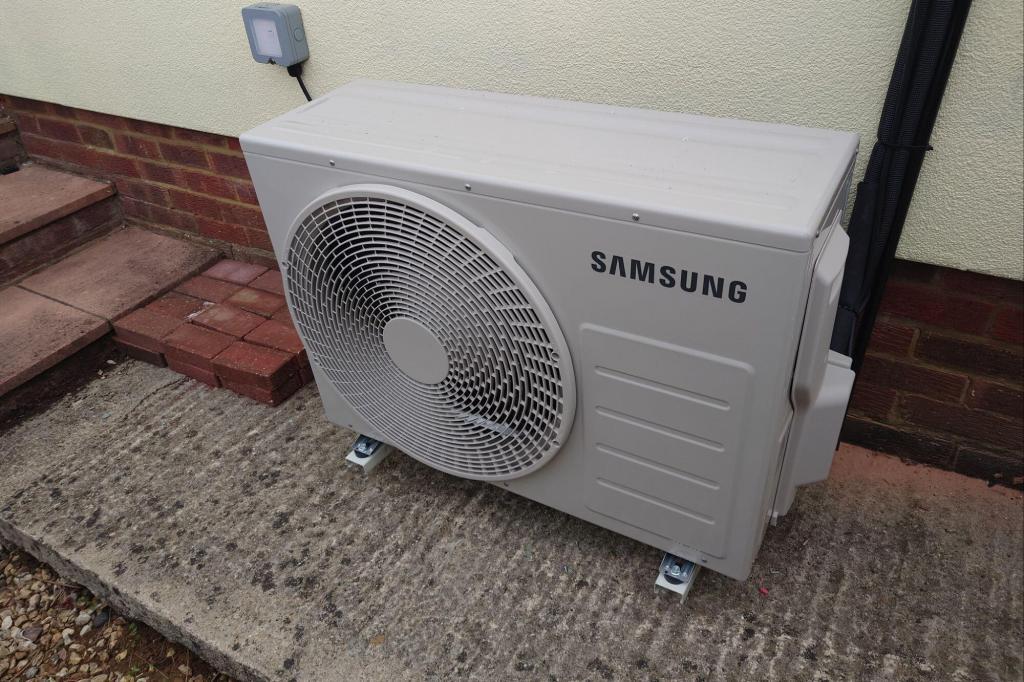
* Samsung: Innovators with their WindFree™ technology. Instead of harsh drafts, Samsung units disperse conditioned air through thousands of micro-holes, providing gentle, even heating and cooling.
* Midea: A cost-effective, high-performing alternative, Midea’s All Easy Pro and BreezeLESS+ lines provide smart Wi-Fi controls, reliable low-ambient operation, and accessible price points.
4. Regional Applicability: South East & East of England Coverage
The South East and East of England feature a high density of residential park home estates. Modern heat pump air conditioning provides an essential energy-upgrade pathway across all towns, cities, and London boroughs in these areas.
Oxfordshire
From rural parks in the Cotswolds to suburban estates, HPAC systems deliver reliable climate control across every major settlement:
* Cities: Oxford.
* Towns: Abingdon-on-Thames, Banbury, Bicester, Burford, Carterton, Chipping Norton, Didcot, Faringdon, Henley-on-Thames, Thame, Wantage, Watlington, Witney, and Woodstock.
Bedfordshire
With flat, wind-exposed geography, park homes across Bedfordshire benefit immensely from responsive HPAC heating:
* Cities & Large Urban Centres: Bedford.
* Towns: Ampthill, Arlesey, Biggleswade, Dunstable, Flitwick, Houghton Regis, Kempston, Leighton Buzzard, Linslade, Luton, Potton, Sandy, Shefford, Stotfold, and Woburn.
Buckinghamshire
Covering the Chiltern Hills down to the Thames Valley, efficient heat pumps reduce off-grid fuel reliance in:
* Cities: Milton Keynes.
* Towns: Amersham, Aylesbury, Beaconsfield, Bletchley, Buckingham, Chesham, Fenny Stratford, High Wycombe, Marlow, Newport Pagnell, Olney, Princes Risborough, Stony Stratford, Wendover, Winslow, and Woburn Sands.
Hertfordshire
In residential communities surrounding commuter hubs, ultra-quiet outdoor split units meet local noise compliance easily:
* Cities: St Albans.
* Towns: Baldock, Berkhamsted, Bishop’s Stortford, BOREHAMWOOD, Broxbourne, Bushey, Cheshunt, Harpenden, Hatfield, Hemel Hempstead, Hertford, Hitchin, Hoddesdon, Letchworth Garden City, Royston, Sawbridgeworth, Stevenage, Tring, Ware, Watford, and Welwyn Garden City.
Essex
Spanning coastal locations and inland towns where summer heat gain in park homes can be extreme:
* Cities: Chelmsford, Colchester, and Southend-on-Sea.
* Towns: Basildon, Billericay, Braintree, Brentwood, Brightlingsea, Burnham-on-Crouch, Canvey Island, Clacton-on-Sea, Coggeshall, Epping, Frinton-on-Sea, Grays, Halstead, Harlow, Harwich, Loughton, Maldon, Manningtree, Ongar, Rayleigh, Rochford, Saffron Walden, South Benfleet, Southminster, Thaxted, Tilbury, Waltham Abbey, Walton-on-the-Naze, Witham, and Wivenhoe.
Kent
The “Garden of England” contains numerous park communities that benefit from all-year heat pump efficiency:
* Cities: Canterbury.
* Towns: Ashford, Broadstairs, Chatham, Cranbrook, Dartford, Deal, Dover, Edenbridge, Faversham, Folkestone, Fordwich, Gillingham, Gravesend, Hawkinge, Herne Bay, Hythe, Lydd, Maidstone, Margate, Minster, New Romney, Northfleet, Paddock Wood, Queenborough, Ramsgate, Rochester, Royal Tunbridge Wells, Sandwich, Sevenoaks, Sheerness, Sittingbourne, Snodland, Swanley, Tenterden, Tonbridge, West Malling, Westerham, and Whitstable.
All 33 London Boroughs (Including the City of London)
For park home estates located within Greater London borders, HPAC systems lower urban carbon footprints and address local heat-island effects:
* City of London
* Barking and Dagenham
* Barnet
* Bexley
* Brent
* Bromley
* Camden
* Croydon
* Ealing
* Enfield
* Greenwich
* Hackney
* Hammersmith and Fulham
* Haringey
* Harrow
* Havering
* Hillingdon
* Hounslow
* Islington
* Kensington and Chelsea
* Kingston upon Thames
* Lambeth
* Lewisham
* Merton
* Newham
* Redbridge
* Richmond upon Thames
* Southwark
* Sutton
* Tower Hamlets
* Waltham Forest
* Wandsworth
* City of Westminster
5. Conclusion
For park home residents across the South East, East of England, and Greater London, traditional heating solutions are rapidly becoming obsolete due to high fuel prices and thermal inefficiency. Installing an air-to-air heat pump air conditioning system manufactured by market leaders like Mitsubishi Electric, Daikin, Toshiba, or Panasonic directly addresses the low thermal mass of park home structures. By delivering year-round temperature stability, reducing energy costs by up to 60%, and offering active dehumidification, heat pumps represent the standard for efficient climate control in modern park home living.